Scroll
For People & Culture Leaders

Where Did The
Work Family Go?

Social infrastructure is the invisible layer beneath every modern organization. The next decade belongs to those who build it intentionally.

The Problem

We Optimized The Office.
We Accidentally Optimized Away
The Culture.

In the six years since COVID, organizations restructured faster than any time in modern memory. Hybrid schedules and hot desks replaced the traditional office. Zoom replaced the conference room. Slack replaced the hallway. Layoffs reshaped headcount and AI compressed teams.

Every one of those changes was rational on paper. But each one unintentionally removed something nobody put on a balance sheet: the same desk neighbours, the same faces at the coffee machine every morning and all of the small, unscheduled moments that quietly build trust and belonging.

What We Improved
  • Communication
  • Flexibility
  • Technology
  • Access to Information
  • Productivity
The office got better.
VS.
What We Lost
  • Trust
  • Familiarity
  • Friendship
  • Belonging
  • Psychological Safety
The relationships got worse.

The result is an invisible, compounding tax on the workforce. Employees feel less connected to their teams. Trust networks fragment. Manager-employee relationships thin out. People matter less to each other than they used to. And by the time it surfaces in engagement scores and turnover numbers, the damage is six to twelve months old.

The U.S. Surgeon General declared loneliness a public health epidemic. Gallup has quantified the cost.

The question is no longer whether disconnection is costing you. It's whether you'll act before the bill arrives in the form of a resignation, retraining costs, or a culture you no longer recognize.

A Diagnostic for Leaders

Six Questions Every Leader
Should Be Able to Answer.

If these questions aren't already on your dashboard — or you can't answer them without checking — you don't have visibility into the layer that drives every metric you do track.

01
How do you know when a high performer is running on empty — before the dip in performance shows up?
02
Which teams have lost the most relational depth in the last 18 months — through remote shifts, re-orgs, turnover, or leadership changes?
03
When a team's performance dips, what's your first diagnostic question — do they not have the capability to do the work, or have they lost the capacity to sustain it?
04
How long does it take a new hire to feel like an insider — and how do you know?
05
Beyond communication tools and one-off events — what's the structure that creates repeated contact between the same people?
06
Gallup has 25 years of data showing employees with a best friend at work are 7× more engaged. How many of yours have a friend (not a teammate or manager)?

Most organizations don't audit their social infrastructure at all. The ones who do only look at it reactively — after engagement scores collapse or their top performer resigns. By that point, the damage is already a year or more old, and what could have been a small intervention has compounded into a financial problem that's costing you in every department.

The Compounded Problem

Here's How The Structural
Damage Shows Up.

What Employees & Teams Feel
Weaker Relationships
Connection thins. Trust fades.
Eroded Belonging
People stop feeling like insiders.
Disengagement
Motivation and effort plummet. People stop giving their best.
Burnout
Sick days climb, mental health claims rise.
Withdrawal & Isolation
People stop showing up to the social parts. Then the work parts.
What The Business Pays
Knowledge Loss
Institutional memory walks out.
Manager–Employee Bonds Break
Trust networks fragment.
90-Day Attrition
New hires never take root.
Top Performers Resign
Top performers resign first.
Lost Productivity
Performance tanks.

These are the metrics every HR team watches. But they're symptoms, not causes. It's akin to mopping the floor while the pipe leaks. You need a solution that fixes the pipe.

What's At Stake

The Cost of Doing Nothing.

5
Additional sick days taken annually by lonely employees.
Loneliness is a health risk equivalent to smoking 15 cigarettes a day. The sick days are the first place it shows up on a balance sheet.
Cigna Loneliness Index, 2020
15%
Annual voluntary turnover in Canadian knowledge work.
Up from 10% pre-pandemic — and climbing across every knowledge-work sector tracked.
Stats Canada labour force survey, knowledge-work segment
$30K
Average cost to replace one Canadian employee.
$30,680 in recruiting, onboarding, lost productivity, and ramp time. Multiply by your turnover rate to see your annual bill.
HR Reporter / Conference Board of Canada
$154B
Lost every year to workplace loneliness.
Every organization is paying this bill. Most haven't named it yet.
Cigna Loneliness Index — absenteeism, productivity, healthcare
In Perspective: A 200-Person Company
30
Resignations
15% turnover applied to 200 people.
$920K
Replacement Cost
At $30,680 per replacement.
6090
Days Ramp Time
Before each replacement is fully productive.
15%
Productivity Loss
Disengagement compounds while the team waits.

Turnover is the metric.
Social disconnection is the cause.

The financial impact doesn't stop at replacement costs. It compounds across knowledge, time, and performance.

The Root Cause

Engagement. Belonging. Retention.
All Downstream of One Biological Mechanism.

That mechanism is called co-regulation.

Co-regulation is the process by which one person's nervous system stabilizes, calms, and finds resilience in the steady, repeated presence of others. When the body trusts the people around it, heart rate slows, stress hormones drop, and attention sharpens. It is the biological reason a hard task feels easier alongside other people, and the reason showing up becomes easier when you are not anonymous.
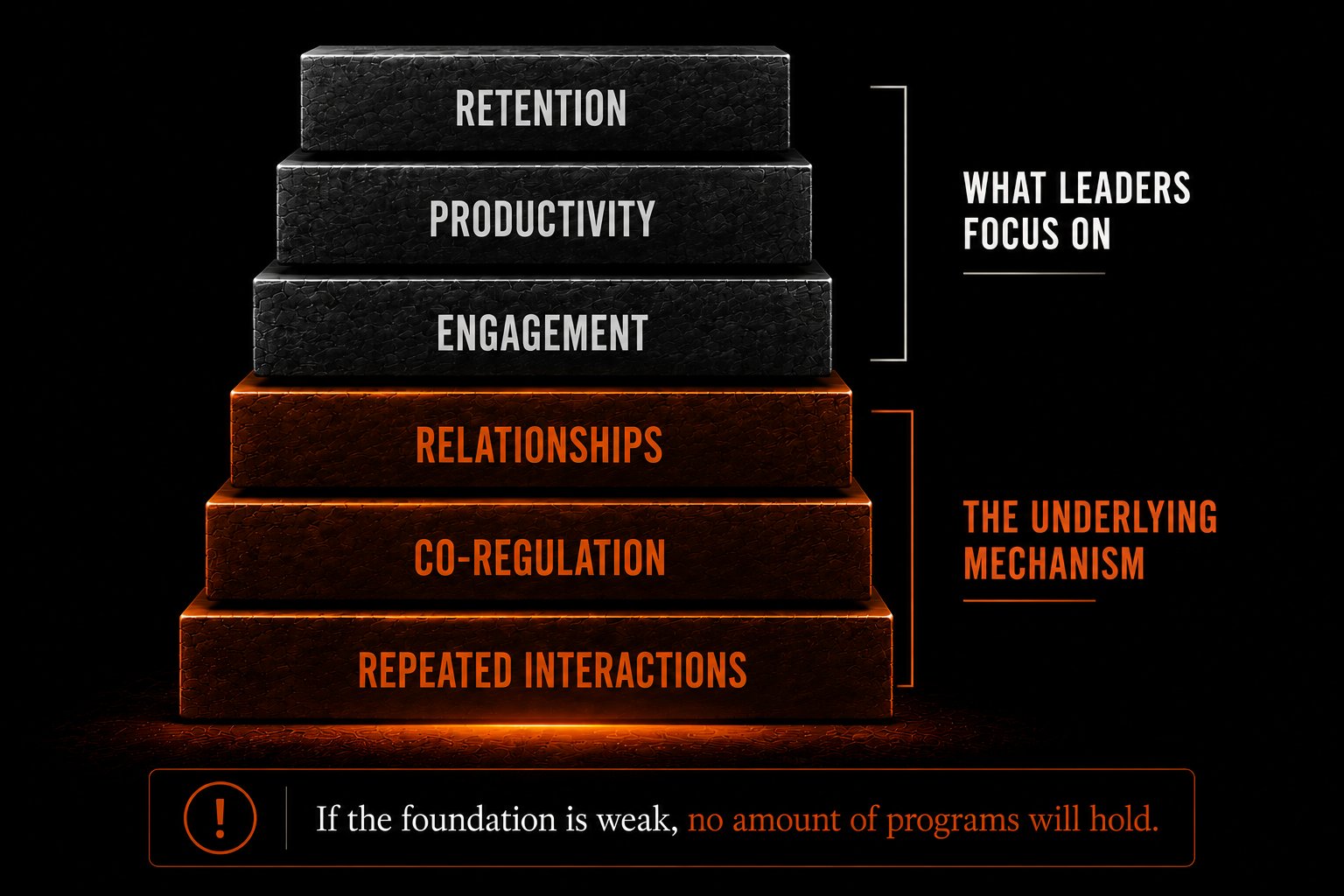
Engagement, Productivity, Retention all downstream of Relationships, Co-Regulation, and Repeated Interaction — a stack diagram.

This biological mechanism is a measurable state the body arrives at when three conditions are met: the same familiar faces, repeated contact, across an extended period of time.

Take any one away and the biology doesn't engage. Co-regulation doesn't happen at an annual offsite, a holiday party, a town hall or a team BBQ. It doesn't happen in a Slack channel or on a Zoom call. It is the unseen layer beneath every engagement score, every retention number, every "psychologically safe" team.

Organizations pour billions into communication infrastructure — Slack, Zoom, Teams, email — the tools that move information between people. But almost nothing into the layer underneath: social infrastructure — the repeated contact, shared experience, and trust that turn a group of individuals into people who actually matter to each other.

One produces output. The other produces culture. You can't buy social infrastructure by spending more on communication tools.

Forge is the first company building social infrastructure as a deliberate organizational investment.

The Solution

Forge Is Not Team Building.
It's Social Infrastructure.
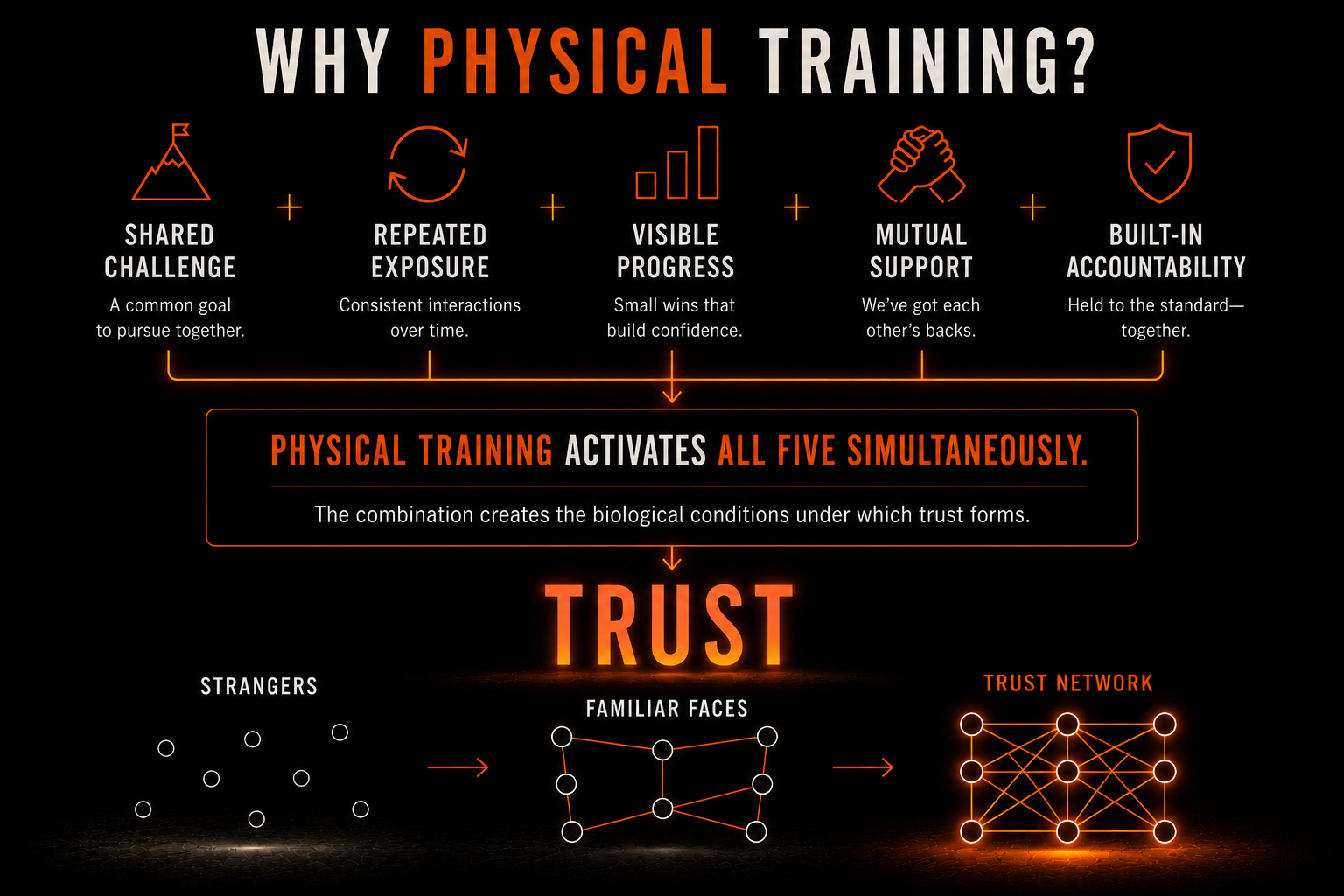
Forge does one thing: brings six to eight of your colleagues into the same room, twice a week, for eight to twelve weeks of structured physical training, led by a trained facilitator.

The blueprint is ancient. Military units. Sports teams. Training partners. Every culture that has produced deep human bonds runs on this same mechanism. Forge is the first to restore it for the modern workplace.

Why Physical Training? Five elements (Shared Challenge, Repeated Exposure, Visible Progress, Mutual Support, Built-in Accountability) converge to build trust. Diagram shows progression from strangers, to familiar faces, to a fully connected trust network. Training invokes all five at once. The combination creates the biological conditions under which trust forms.
01
Closed Cohort The same 6–8 people, every session. No drop-ins. No rotating faces. Predictability is what the nervous system reads as safety.
02
Shared Physical Effort The nervous system bonds to people it has worked beside, not talked beside. Synchronized physical effort triggers two things: interpersonal entrainment (the measurable alignment of two bodies' rhythms) and right-brain-to-right-brain communication (nonverbal, unconscious interfacing before the conscious mind catches up).
03
Sustained Over Time 8–12 weeks. Long enough for genuine bonds to form because of the sustained, coordinated effort, and repeated exposure. When a cohort wants to continue together, Forge offers the option to renew.
04
Expert Facilitation Our Forge facilitators are trained fitness professionals who know how to hold a room, and create the conditions a group of strangers needs to become a unit. They set the rhythm of the program and hold the container so belonging has somewhere to form.

Imagine a company that doubles as a third space. Where the person two desks over knows your partner's name, asks about your kid's game on Monday, remembers that last quarter was hard for you.

That is not nostalgia. That is biology operating the way it was designed to, inside a structure built to make it happen.

How It Works

Three Deployment Models.
One Operating System.

Your organization purchases a cohort allocation. Forge handles the operational side of intake and runs the program. Who fills each seat is up to you — self-selection, strategic allocation, a recognition reward, or as part of an existing wellness or learning budget.

01

New Hire
Integration

Build belonging before attrition begins.

  • 8 new hires
  • 8 weeks
  • Accelerated relationship building
  • Faster cultural integration
Best For:
Remote teams · High growth · New hire classes
02

Cross-Functional
Cohesion

Reconnect the relationships org charts break.

  • Mixed departments
  • Rebuild trust
  • Increase collaboration
  • Reduce silos
Best For:
Reorgs · M&A · Hybrid companies
03

Leadership Layer
Bonding

Strengthen the trust network leadership depends on.

  • Emerging leaders
  • Manager cohorts
  • Executive teams
  • High-potentials
Best For:
Scaling companies · Leadership development

One Forge playbook. Three places to run it.

Next Step

Let's Talk About
Your Team.

We help you strengthen your organization's social infrastructure before disengagement becomes turnover.

Deployment 01
New Hire Integration
Deployment 02
Cross-Functional Cohesion
Deployment 03
Leadership Layer Bonding

The strongest teams in the world aren't lucky. Their conditions are engineered.

Book Your Social Infrastructure Audit Email Us
joinforge.ca